The Postdoc Experience
An insecure career stage, from Europe to Aarhus
Postdoc appreciation week

This September, Aarhus University will celebrate Postdoc Appreciation Week (PAW), a week dedicated to recognising the valuable contributions of postdoctoral researchers and strengthening connections across the AU community.
The puzzle
65% of postdocs plan to base their career in academia. It is “extremely unlikely that 65% will end up in tenured or in long-term academic positions in their fields” (Nordling 2023b).
The contract treadmill
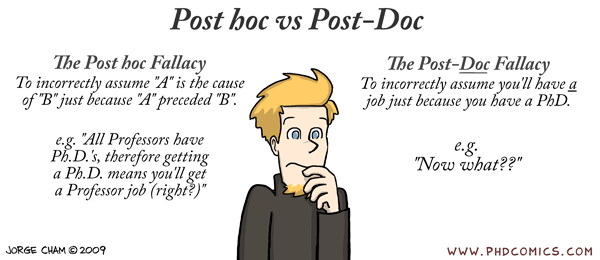
- 41.5% of European postdocs have already held three or more temporary research contracts
- 78.7% have less than two years left on their current one
- Only 1.2% hold a permanent contract (Parada et al. 2025)

Mobility as the default
- 74.4% of European postdocs have lived in two or more countries since their master’s degree (Parada et al. 2025)
- 54% of Nature’s respondents have moved country to take up a postdoc (Research 2023)
- Mobility is uneven: postdocs in Northern and Western Europe move the most, while 55.8% of those in Southern Europe stay at the institution where they did their PhD (Parada et al. 2025)

The two-body problem
16% of European postdocs live apart from their partner or commute between countries for work (Parada et al. 2025).
“We have one big move left. We won’t move any more for postdocs,” said Manuel Chevalier, after eight years of postdocs in three countries (Nordling 2023a).

Mental health and work-life balance
- 52% of postdocs have considered leaving science because of anxiety, depression, or related concerns (Research 2023)
- In Europe, 52.9% report an imbalance between work and non-work life; 29% rate their balance as bad or very bad (Parada et al. 2025)
- Among those most affected, reasons cluster around precarity: uncertain job opportunities (58.5%), temporary contracts (58.6%), and lack of stable income (41.9%) (Parada et al. 2025)

The local psychological environment
Two of four faculty-specific items score below the department’s overall average (Workplace Assessment (WPA) 2025 2025a):
- 3.2 for the department working with the psychological work environment “in a relevant manner”, the lowest-scoring item
- 3.3 for feeling adequately supported to pursue external funding without undue stress

The open question
Structural, not individual: what can universities do?